Words
In second grade they taught us to write, and from then on through high school, the poems tumbled out. Then came college, and my father called in his loan—all those years of parenting forced on him by my mother's untimely death. Time to step up, Laurie!
Never could set poetry entirely aside, though. Then a recent move shook loose some pebbles and one of them started an avalanche. More…
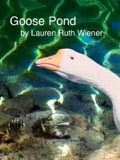
What if we took animals seriously? Goose Pond is a story told by flightless domestic geese trying to survive in the wild.
Gam the goose has spent her whole life in the security of her barnyard. When Seabreeze Farm is put up for sale, she escapes captivity to find her way to a large pond gleaming in a patch of marshland by the sea.
Ganser is a young gander bred on a factory farm. When the truck transporting him to slaughter crashes on the highway, Gam finds him and his friend Grayling—the only survivors—and leads them back to the pond.
Learning to live as wild animals, Gam and the traumatized youngsters bond to form a family of sorts. And the community of wild birds takes them in, all helping one another to overcome cold, storms, and the occasional predator. The pond could be their sanctuary—if only people would leave it alone! Instead, over the course of two years, this vulnerable community faces a mounting assault from vandalism, pollution, habitat loss, and climate change. From all sides, people threaten their precious but vanishing world.
This novella is an invitation: allow yourself to really imagine the lives of other creatures; they have their own agendas, and their struggles are as desperate for them as ours are for us. If we were more alive to this level of tragedy, might we change how we behave toward the natural world?
Goose Pond is a microcosm: the universe in a grain of sand.
Coming soon—stay tuned.
A single instant can change your whole life. Mine changed on April 1, 1960, when my mother, reading in bed late at night, slumped over and died of a cerebral aneurysm. She was 42. I was six.
Thus began the bizarre amalgam of abuse, neglect, and unsupervised international travel that was my personal wild ride through the sixties. A riveting first-person account, Riding the Cyclone careens like the eponymous Coney Island roller coaster from the wisecracks of a prematurely cynical kid to the gut-wrenching brutality that caused it, as my private world of capricious violence and unhinged delusion is mirrored by the Sixties' assassinations, drugs, and the sexual revolution.

In 1999, I began a music diary to capture the soundtrack of my life. And because the Web was so shiny and new, I decided to keep it online.It was great while it lasted; maybe I'll try it again someday. For fans of world music, here are the Mongrel Music archives.
Smartphones, self-driving cars, fake news, identity theft, cyberstalking… it was all in the future once.In the early '90s, when the World Wide Web consisted of two nodes connecting CERN with Stanford and most people had yet to encounter a computer, I started growing concerned about certain ill-informed and hazardous decisions I saw being made: keeping sensitive data on wide-open systems, putting cars' brakes under software control, committing heaps of public money to excessively ambitious software projects (remember SDI?). Okay, I thought, if I explain the problem clearly, accurately, and entertainingly, surely some of those decisions might become more well-informed and cautious? So, in 250 crisp clear and occasionally humorous pages, Digital Woes explained what software is, how it's made, and why mistakes and unintended interactions—bugs—are inevitable. Therefore, I suggested, humility and restraint might be in order when proposing, designing, and building digital systems. Sigh. The young can be so naïve. And the past can look so quaint, when you think about what's coming:— Why bother with gun control laws when we have home 3D printers? Throw in a wiki or two dedicated to Everyman's freedom to own a military arsenal, and the whole idea of gun control becomes a sick joke. — You can already buy miniaturized spy gear; GPS navigation, long-range control, and live video streaming are all well established. When drones the size of dragonflies become cheap and ubiquitous, then (as Isaac Asimov memorably wrote in a story titled "The Dead Past") welcome to the goldfish bowl. — If the Internet of Hackable Things doesn't get us there first. — And, about those self-driving cars? Not that navigation and driver-assist systems are easy problems, but the real world has thunderstorms and mudslides and spilled loads and oblivious people driving 1968 Volkswagens and kids chasing balls out into the street and bicyclists running stop signs and drunks and speeders and hastily scheduled roadwork. As various unfortunate Tesla drivers have discovered, this is all far from ready for field-testing. And plans to network all the cars and traffic signals together make the whole thing vulnerable to random interference and malicious hackers. — Yes, self-driving cars would be a blessing for the blind, the elderly, people trapped in long commutes… not to mention surveillance and law enforcement. "I'm sorry" says your car as it exits the freeway miles too soon, "but your destination is now in a secure area. Access denied." I really should write Digital Woes 2.0. But it's all too depressing.
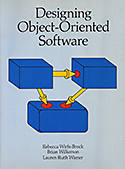
How many technical books are still in print after half a lifetime? Nice to think it wasn't all ephemeral. I'm still proud of Designing Object-Oriented Software, written with my colleagues Brian Wilkerson & Rebecca Wirfs-Brock (Prentice-Hall, 1990). This book grew out of work done by the Tektronix Smalltalk-80 group at Tek Labs in the '80s. It felt good to argue for the cause, to do work that mattered. With object-oriented languages now in widespread use, evidently our views prevailed. Imagine that.For software developers, this practical and down-to-earth bestseller explains the concepts of object-oriented programming, presents a process to apply those concepts, and gives examples that pull it all together.